


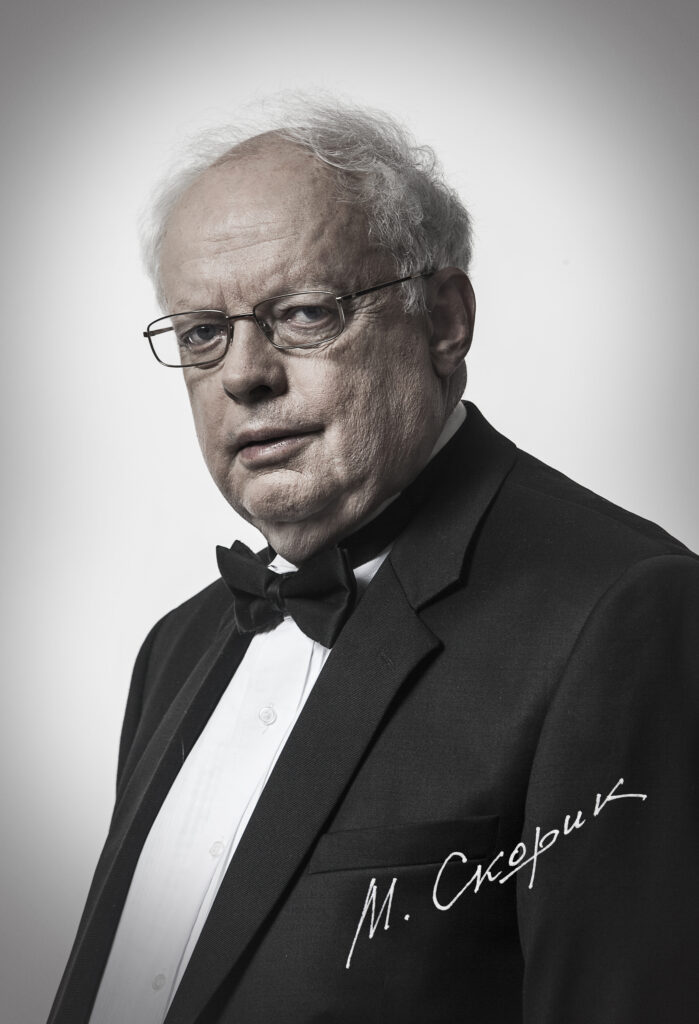
Myroslav Skoryk —
an outstanding composer, pedagogue, musicologist, conductor, pianist, and public figure. A Hero of Ukraine, People’s Artist of Ukraine, laureate of the Taras Shevchenko National Prize of Ukraine, and Academician of the National Academy of Arts of Ukraine.
Myroslav Skoryk was born on July 13, 1938, in Lviv. He came from an intellectual family: his grandmother was the sister of the world-renowned opera singer Solomiya Krushelnytska, who was among the first to recognize the boy’s exceptional musical talent. Skoryk began his musical education at music school in Lviv in 1945.
In 1947, the Skoryk family was politically repressed and deported to Siberia. There, Myroslav Skoryk continued his piano studies with Valentina Kantorova, a student of Sergei Rachmaninoff.
After Stalin’s death, the family was able to return to Lviv. From 1955 to 1960, Skoryk studied at the Lviv Conservatory (now the Lviv National Music Academy named after Mykola Lysenko) under the guidance of Stanislav Liudkevych, Roman Simovych, and Adam Soltys. His diploma work was the cantata Spring (Vesna) based on poetry by Ivan Franko.
From 1960 to 1963, he pursued postgraduate studies in composition at the Moscow Conservatory named after Pyotr Ilyich Tchaikovsky under the supervision of Professor Dmitri Kabalevsky. In 1964, he completed his studies with a dissertation entitled Modal Features of Sergei Prokofiev’s Music and obtained the academic degree of Candidate of Art Studies (PhD equivalent).
On 1963 Skoryk started teaching at the Lviv Conservatory, and from 1966 at the Kyiv Conservatory (now the National Music Academy of Ukraine), lecturing in composition and music theory. He became an Associate Professor in 1971 and a Full Professor in 1985. Over the decades, he educated an entire generation of prominent composers, including Osvaldas Balakauskas (Lithuania), Yevhen Stankovych, Ivan Karabyts, Hanna Havrylets, Oleh Kyva, Viktor Stepurko, Oleksandr Kozarenko, Bohdana Froliak, Viktor Telychko, Ivan Nebesnyi, Lesia Horova, Volodymyr Zubytskyi, Mykhailo Shved, and many others.
Skoryk’s artistic legacy encompasses nearly all musical genres: opera, five ballets, a Requiem, instrumental concertos (ten for violin, three for piano, two for cello, as well as concertos for viola and oboe), works for symphonic and chamber orchestra, chamber music, and compositions for piano, both solo and four hands.
The generation of the 1960s remembers his iconic popular songs, including the blues-tango Paint Me the Night (Namaliui meni nich) and the first Ukrainian twist Do Not Trample the Lilies of the Valley (Ne topchit konvalii). Skoryk took an active part in the creation of the landmark film Shadows of Forgotten Ancestors directed by Sergei Parajanov.
His opera Moses (Moïsei) remains the only musical work in Ukraine to have received the blessing of Pope John Paul II, while the legendary Melody (Melodiia) has become a spiritual musical anthem of Ukraine.
Myroslav Skoryk prepared editorial versions of operatic works by Ukrainian classical composers, including On Mermaid Easter by Mykola Leontovych, Kupalo by Anatol Vakhnianyn, Roksolana by Denys Sichynskyi, A Zaporozhian Beyond the Danube by Semen Hulak-Artemovskyi, and Natalka Poltavka by Mykola Lysenko.
In his compositional style, Skoryk continued the traditions of the Lviv school while offering a modern and deeply personal vision of Ukrainian musical identity. His music draws on Carpathian folklore, Lviv’s urban and salon traditions, elements of contemporary popular music, and even jazz, blending them into a distinctive and instantly recognizable musical language.
Throughout his life, Skoryk headed many of Ukraine’s leading cultural institutions, including the first Chervona Ruta Festival (1989, Chairman of the Jury), the International Festival Kyiv Music Fest (2002–2019, Artistic Director), the National Union of Composers of Ukraine (2006–2010, Co-Chairman; 2011–2020, Honorary Co-Chairman), and the National Opera of Ukraine (2011–2016, Artistic Director).
Today, Skoryk’s works are performed on every continent except Antarctica. Over the past five years, his music has been most frequently performed in Poland, Germany, France, Austria, the Baltic countries, the United Kingdom, the United States, and Canada.
Today, Myroslav Skoryk’s name is carried by the Lviv National Philharmonic, a music college in the city of Kamianske, the Center for Ukrainian Studies at the National Music Academy of Ukraine, as well as concert halls and numerous streets throughout Ukraine.
Myroslav Skoryk’s music captivates above all through its melodic voice — a voice that transcends stylistic borders and speaks to listeners regardless of their musical background. From the most delicate lyricism to moments of exuberant joy, from deep tragedy to quiet reflection, his works form a rich emotional landscape shaped by an unwavering sense of human truth.
“Music should be written in such a way that people want to listen to it,” Skoryk often said. This simple yet profound belief became the cornerstone of a musical legacy addressed not to fashion or doctrine, but to the human soul itself.
DOWNLOAD
BIOGRAPHY
